
Hilo is a simple high-or-low card game: a card appears‚ and you predict whether the next one will rank higher or lower. Its rules are easy to grasp‚ but the question of whether the game’s return to player (RTP) changes according to a player’s country deserves a closer look. The short answer is that location alone should not be assumed to alter the odds. The exact version‚ published rules‚ and operator settings matter more.
This review looks at how Hilo works‚ what RTP can and cannot tell you‚ and how players around the world can check the details before wagering. Since online casinos may offer different providers‚ configurations‚ currencies‚ and legal terms in different markets‚ there is no universal RTP figure that can safely be applied to every game called Hilo.
How Hilo Works
In a typical Hilo round‚ the game shows a starting card and asks you to choose whether the next card will be higher or lower. Depending on the version‚ you may also be able to choose “same‚” skip a prediction‚ or collect a displayed amount before continuing. A correct call advances the round and may increase the potential payout; a wrong call usually ends the run and loses the amount at risk.
Card values and special rules vary. Aces might count as low‚ high‚ or be treated according to a specific rule set. The handling of ties can also differ: a tie may count as a loss‚ a win‚ or a separate outcome. These details affect the chance of a successful prediction‚ so read the in-game help panel rather than relying on assumptions based on another Hilo title.
Why the next card is not simply a guess
Some versions draw from a deck or shoe where the current card is removed‚ meaning the number of cards of each rank left in play changes as rounds progress. Others may use a different virtual-card model. The screen’s history can help you understand what has happened in a session‚ but it does not guarantee what will happen next. Past outcomes are not a dependable way to predict future cards.
Does RTP Change by Country?
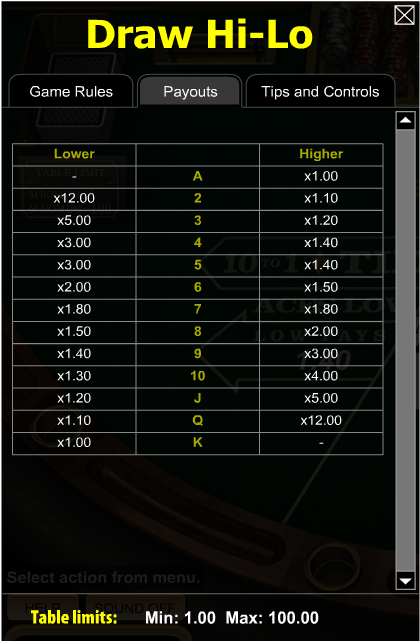
RTP is a long-run theoretical measure: it estimates the portion of total wagers a game returns over a very large number of plays. It is not a promise that an individual player will receive that percentage‚ or that a short session will produce a result close to it. A game can show substantial variance from its theoretical return in either direction.
Country-specific differences are possible in online gambling‚ but they should be verified rather than presumed. An operator may offer a particular game build or configuration in one market and a different approved version elsewhere. Regional rules may also affect which products are available‚ how promotions work‚ or what information must be displayed. These factors do not prove that a provider secretly changes the outcome of each card based on a player’s location.
To assess a specific Hilo game‚ check its information or paytable screen for the stated RTP‚ rules‚ and provider. Then compare that information with the casino’s terms and the provider’s official material‚ if available. Make sure you are looking at the same game title and version. If the casino does not publish an RTP‚ ask support where the figure can be found; do not treat an answer from a forum or a search result as confirmation for your exact game.
What to check before playing
- Game identity: Confirm the provider and full title shown in the game.
- Rules: Review card values‚ tie outcomes‚ and any special options.
- RTP information: Look for a stated figure in the game’s help section or official documentation.
- Market terms: Read the casino’s local terms‚ including restrictions and any relevant game disclosures.
- Support response: If details are unclear‚ ask support to identify the version and its published RTP.
A country setting‚ language‚ or currency display is not by itself evidence of a different RTP. Likewise‚ seeing the same game name at two casinos does not establish that both use precisely the same configuration. The most reliable comparison is based on version-specific information‚ not on a broad claim about a country.
Playing Hilo at an Online Casino
Hilo’s brisk rounds make it easy to start playing‚ but speed can also make it easy to lose track of spending. Before opening the game‚ check that the casino is legally available to you and that the operator’s account‚ payment‚ and verification rules are clear. Access and licensing differ across jurisdictions‚ so a casino that serves one player may not accept another.
Where a demo mode is offered‚ it can be useful for learning the interface and testing how the rules are presented without risking real money. Demo results do not predict real-money outcomes‚ and they may not be a reliable way to verify an RTP. If you decide to play for money‚ set a budget and a time limit in advance. Treat the stake as entertainment spending‚ not as a way to earn income.
Some players search for the best time to play quick casino card games‚ but Hilo’s mathematical odds are not improved by playing at a particular hour. A late-night session‚ a winning streak‚ or a recent run of low cards does not make the next prediction more favorable. Choose a time when you can focus‚ stop when your limits are reached‚ and avoid playing when tired or under pressure.
Basic Odds and Risk
The chance of a correct call depends on the current card‚ the rules‚ and the remaining card distribution in the particular version. For example‚ a middle-ranked card may have more ranks above it than a high card‚ but the exact probability still depends on whether ties count and how the game handles cards already dealt. This is why a general “higher or lower” percentage cannot accurately describe every Hilo game.
Even when a displayed probability is available‚ it should be read as an estimate for a defined outcome‚ not a guarantee of profit. A correct prediction may increase a potential payout‚ but continuing also puts accumulated winnings or the current stake at risk. Choosing to collect can reduce exposure‚ while continuing offers a chance at a larger return alongside a greater possibility of losing the run. Neither choice removes the house edge‚ if one applies to the game’s payout structure.
A practical way to compare outcomes
Use the game’s own odds display‚ if provided‚ and check what it measures. Does it show the probability of the next card being higher‚ the probability of winning the whole round‚ or a payout multiplier? Those are different figures. A multiplier is not the same as an RTP‚ and a probability for one decision does not describe the expected return across a complete session.
Players should also avoid relying on betting progressions as a solution to unfavorable odds. Increasing a stake after a loss can magnify losses quickly‚ and no staking pattern changes the cards that the game can produce. A cautious stake and a firm stop point are more useful safeguards than a system that claims to guarantee recovery.
Questions and Answers
Can the casino change Hilo’s RTP for my country?
A market-specific version or configuration may exist‚ but you should not infer that from your location alone. Check the exact game’s published information and ask the operator or provider about the version available in your jurisdiction. If no source confirms a country-based change‚ treat the claim as unverified.
Is RTP the same as the chance of winning a round?
No. RTP is a theoretical long-run return across wagers. The chance of a correct high-or-low call is an outcome probability for a particular decision. A player can win a round while receiving less than the theoretical RTP over a short session‚ or lose despite a game’s published return.
Does the card history help predict the next result?
It can show which cards appeared in the current run‚ and in some versions that may affect the remaining card distribution. But it does not reveal a guaranteed next card. Follow the game’s rules and probability display rather than assuming a pattern must continue or reverse.
What should I do if the RTP is not displayed?
Check the game help menu‚ the casino’s game information page‚ and official provider documentation. If the figure remains unavailable‚ contact customer support and request a source for the exact title and version. You can also choose not to wager until the information is clear.
Verdict
Hilo is an accessible card game built around quick decisions‚ changing probabilities‚ and the choice between continuing and collecting. Its simplicity should not be confused with predictable results. The key question—whether RTP varies by country—cannot be answered universally for every game carrying the Hilo name. Regional availability and configurations can differ‚ but location alone does not establish that the RTP has changed.
For a trustworthy answer‚ identify the provider and version‚ read its rules‚ and check an official or operator-published RTP disclosure for the market where you play. If the casino cannot clarify the information‚ do not rely on assumptions about another country’s game. Play only where permitted‚ set firm limits‚ and remember that RTP describes long-run theoretical behavior—not a personal outcome or a promise of winnings.